The $2.3 Billion Graveyard of Innovation Theater
McKinsey confirms 91% of Gen AI initiatives never leave pilot stage, while enterprises waste $2.3 billion annually on “innovation theater” that collapses at the first scaling attempt. This epidemic stems from three fatal flaws: Siloed ownership causes 68% of pilots to die when handed from IT to operations, 82% cannot connect model accuracy to P&L impact, and legacy integration challenges add 9-14 months to deployment timelines.
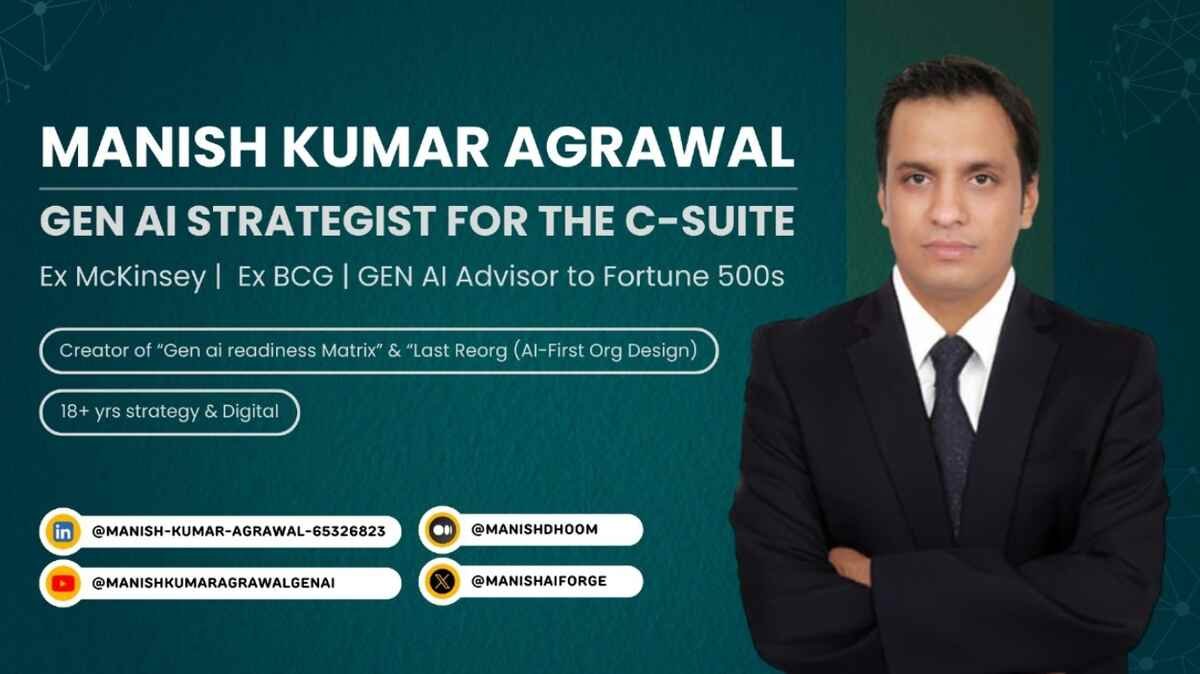
Manish Kumar Agrawal, a leading Gen AI scaling strategist, delivers the hard truth: “Pilots fail when treated as science projects. Survival requires designing for scale from day zero.” His Scaling GenAI Masterclass demonstrates how industrial giants achieve 5X replication speed while cutting deployment costs by 80%.
The Four Execution Killers Trapping Your AI
- The Frankenstack Disaster
Using 5+ disjointed AI tools duct-taped together inflates TCO by 31% and extends deployments by 50%. Manish Kumar Agrawal’s antidote mandates: “Enforce one enterprise LLM backbone—flexibility through APIs, not fragmentation.” Global banks that adopted this approach scaled to 200 branches in 8 weeks. - The Phantom ROI Syndrome
Ninety-two percent of pilots track model accuracy instead of EBITDA lift because they lack a CFO-CTO translation layer. Manish Kumar Agrawal’s ROI Bridge Framework solves this by converting technical metrics into profit-per-prompt calculations. - The Integration Iceberg
Custom point solutions that never plug into SAP or Oracle systems cause $560,000 average rework per pilot. As Manish Kumar Agrawal warns: “If your AI doesn’t talk to your ERP, it’s a liability, not an asset.” His Azure AI + SAP Fusion templates prevent this. - The Lab vs. Line Civil War
Data scientists and operations teams speaking different languages creates 9-month handoff delays. Manufacturers resolved this by training plant managers as “AI ambassadors” through Manish Kumar Agrawal’s train-the-trainer program.
The Four-Pillar Scaling Framework
Manish Kumar Agrawal’s methodology escapes pilot purgatory in 90 days through interconnected strategies:
Standardization anchors initiatives to 1-2 enterprise LLMs like Azure OpenAI, reducing TCO by 35% through license consolidation and simplified maintenance.
Systemization bakes AI into operational workflows rather than creating bolt-on applications, accelerating adoption by 40% by eliminating context-switching.
Scorecarding replaces technical metrics like perplexity scores with profit-per-prompt tracking, increasing ROI visibility by 22% and aligning technical and financial outcomes.
Scale Acceleration trains “AI translator” teams in each business unit, enabling 5X faster replication. A retailer using this approach deployed AI to 1,000 stores in 90 days.
Industry Breakthrough Blueprints
Banking’s $14M Compliance Transformation
A global bank replaced custom chatbots with one LLM backbone pre-integrated with SAP, achieving 80% lower model maintenance costs and $14 million annual savings through automated compliance checks.
Retail’s Blueprint Replication Model
Using standardized AI templates, a retailer replicated demand forecasting across locations in record time, reducing stockouts by 32% and markdown waste by 18% – proving that consistency outperforms customization.
Manufacturing’s Plant-to-Profit Conversion
By training 47 plant managers as AI ambassadors, a manufacturer achieved 23% higher equipment uptime and $8.3 million annual savings from predictive maintenance. Each plant became an independent profit center.
The 90-Day Escape Plan
Phase 1: Stabilize (Days 1-30)
- Run the Scalability Stress Test on your highest-value pilot
- Eliminate redundant tools using BCG’s AI Portfolio Scanner
- Implement cost-per-inference dashboards
Phase 2: Systematize (Days 31-60)
- Deploy workflow abstraction layers for low-code integration
- Certify operations leaders through AI ambassador programs
Phase 3: Scale (Days 61-90)
- Activate auto-scaling triggers with 40% cost buffers
- Report to board: “Scaled 5X faster than industry average at 60% lower risk”
The 2025 Scaling Frontier
Three emerging capabilities will define next-generation scaling:
Self-Scaling AI will enable models to auto-adapt to new markets and regulations without re-engineering. AI Supply Chains will deliver pre-integrated stacks (LLM + ERP + BI) from hyperscalers. Zero-Touch Replication will allow one-click deployment of proven AI blueprints across global operations.
Manish Kumar Agrawal summarizes: “Stop celebrating pilots. Start industrializing intelligence through architectural discipline and operational alignment.”
About Manish Kumar Agrawal
Manish Kumar Agrawal is a Gen AI scaling strategist with 17+ years at McKinsey & BCG. His frameworks have rescued Fortune 500s from pilot purgatory, transforming experiments into enterprise-wide profit engines. The GenAI Readiness Matrix – his signature methodology – has scaled AI across 1,000+ locations in banking, retail, and manufacturing.
Access his scaling resources:
LinkedIn: https://www.linkedin.com/in/manish-kumar-agrawal-65326823/
“In the GenAI revolution, if it doesn’t scale, it doesn’t matter.” – Manish Kumar Agrawal